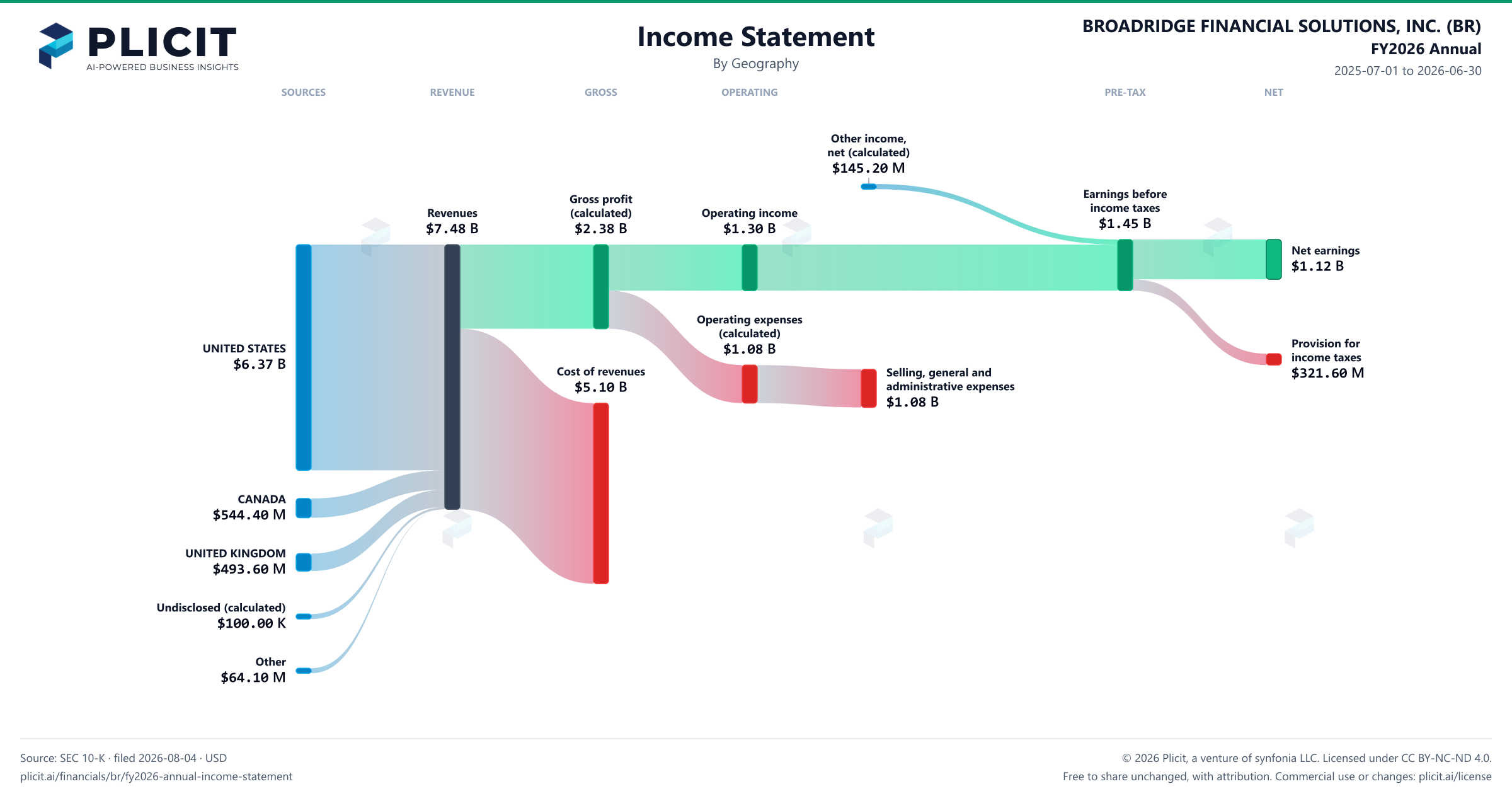
Canada overtook Britain abroad, but America still supplies 85% of Broadridge's sales
Broadridge is an American business with a foreign sideline that earns less. In the year to June 30, 2026, the United States supplied $6.37 B of $7.48 B in sales, 85% of the total. Of the $587.70 M rise in revenue, $467.60 M came from home, where growth sped up to 7.9% from 5.1% the year before. Abroad, operations brought in 15% of sales but only 11% of pretax income. That gap is the first clue that business outside the United States is costing more to earn.
Why does Canada now outrank Britain? Canada grew to $544.40 M from $463.80 M, while the United Kingdom inched to $493.60 M from $464.70 M, the slowest of any region at 6.2%. Canada's share of revenue rose to 7.3% from 6.7%. The fastest grower was the small Other bucket, up 20% to $64.10 M. Foreign sales rose to 15% of revenue from 14% a year earlier. None of this changes the core fact: growth abroad is real but small, and the home market did most of the lifting.
For investors, the foreign business is a modest diversifier, not a new growth engine. One caveat on the profit split: this year's pretax income includes $227.0 M of non-cash digital asset gains, and the domestic and foreign split does not show which side booked them. If the coin gains sit at home, the gap between foreign sales and foreign profit is narrower than it looks. Is Broadridge's slower-earning foreign business a margin problem, or simply the price of building in Canada and Britain?