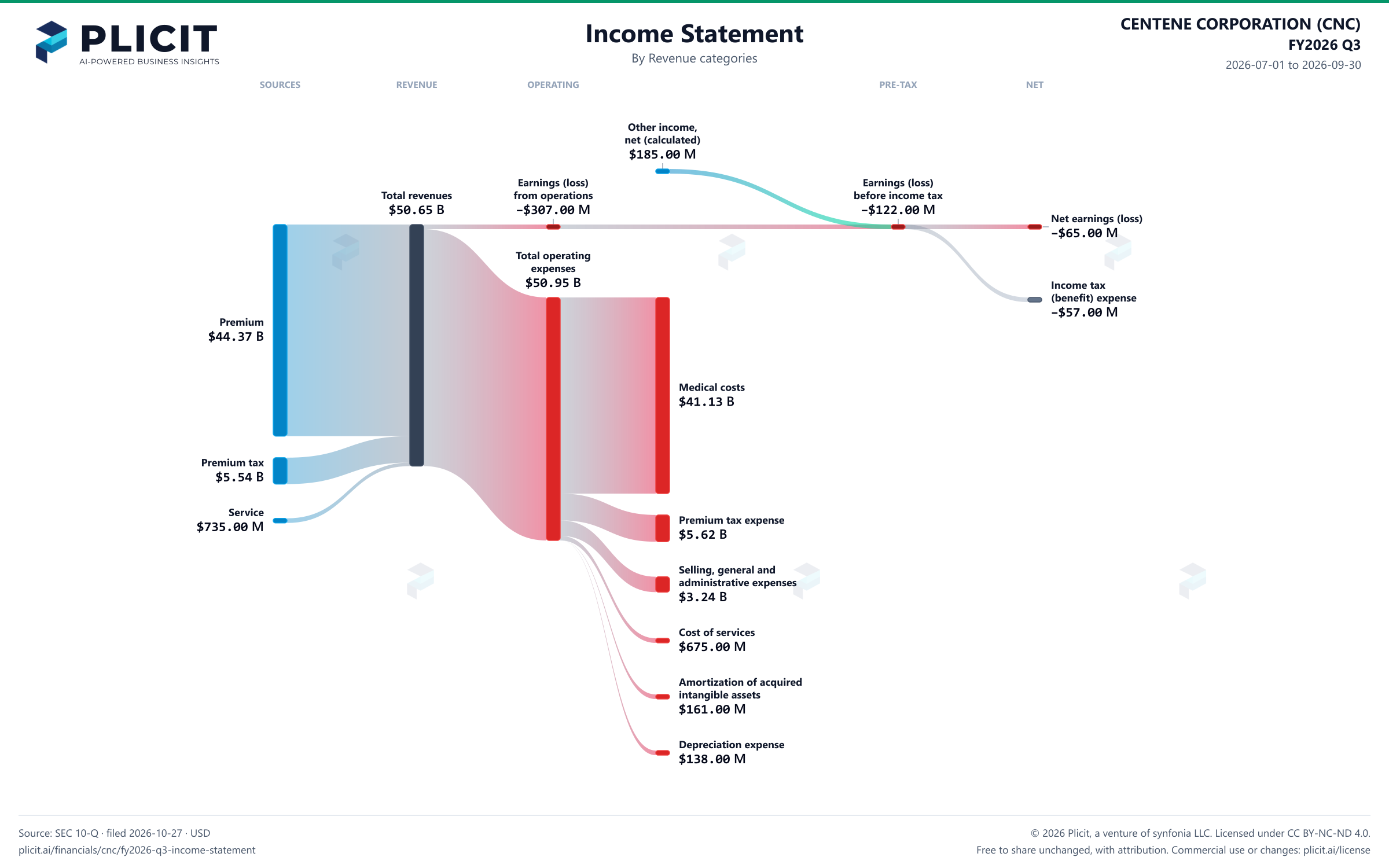
Centene's revenue rose 2%, but its operations lost $307.00 M
Centene's revenue rose 2% this quarter, to $50.65 B, yet earnings from operations were a loss of $307.00 M. That number is the one to hold onto, because the revenue headline leans on a pass-through line. Premium tax, which carries state pass-through money, rose 16% and now makes up 11% of revenue. Its premium tax line grew faster than premium, which is a sign the headline is being carried by money the company passes along. Premium and service revenue, the business itself, barely moved.
The loss looks smaller than last year's mostly because last year carried a $6.74 B impairment. Take that out and last year's quarter was a $211.00 M loss, which makes this year's $307.00 M loss worse, not better. Medical costs held steady at a 92.7% ratio, unchanged from a year earlier, the filing says. That is not where the loss came from. Enterprise optimization costs of $297.00 M sit in selling and overhead costs. Without them, the quarter would be a loss of about $10.00 M.
Premium tax adds to the gap as well. Its expense of $5.62 B ran ahead of the $5.54 B the line earned, a pass-through that costs about $75.00 M a quarter. The filing expects another $50 million to $100 million of severance for the rest of 2026. Those charges sit above the operating line, so each one lowers reported earnings directly. That is why the question matters to anyone holding the stock or the bonds. Will the optimization costs end with the program, or become the normal cost of running Centene?