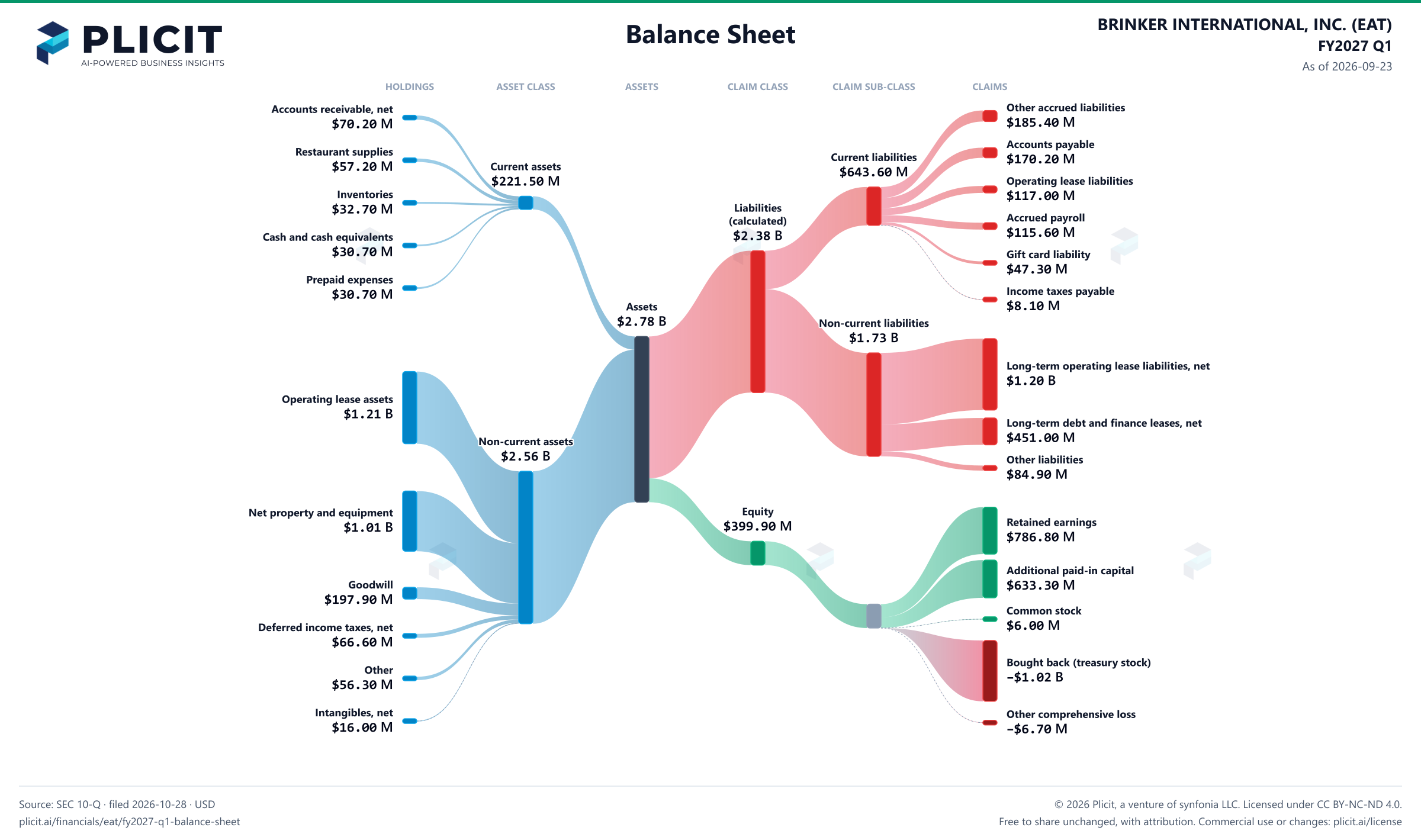
Brinker's cash fell 72% as its borrowing climbed
Brinker's cash fell from $110.00 M to $30.70 M in a single quarter, a drop of 72%. Over the same stretch, its long-term debt and finance leases climbed from $419.70 M to $451.00 M. Counting the $33.80 M due within a year, the total it owed reached $484.80 M. Debt rose while cash fell, and that pairing is the one to test. A company that borrows to hold cash is in a different position from one that borrows to pay out cash, and the balance sheet alone cannot say which Brinker is.
The filing names the trigger: on July 15, 2026, Brinker redeemed its $350.0 M of 8.25% notes for a total cash outflow of $378.9 M, funded with revolver borrowings. The loss from the early payoff, $17.6 M, was booked in interest expense. The new line is cheaper on paper: its rate was 5.15% at quarter-end, against the 8.25% notes it replaced. Most of what Brinker owes is not borrowing: its lease liabilities to landlords, $1.31 B, are 55% of its $2.38 B of liabilities. Those leases also carry a warning sign in the notes: Brinker has received notices of default on leases it guaranteed for restaurants it sold.
The cash cushion is thin against the debt, and the quarter's cash flow shows where the money went. Watch the cash balance, which ended at $30.70 M, and the revolver, which stood at $375.0 M. If the revolver stays drawn while buybacks continue, the company is financing its shareholder payouts with lenders' money. Management says it expects to remain in compliance with its covenants. The filing gives no covenant ratio to test that against. Will Brinker pay the revolver down from operating cash, or keep borrowing to fund its buybacks?