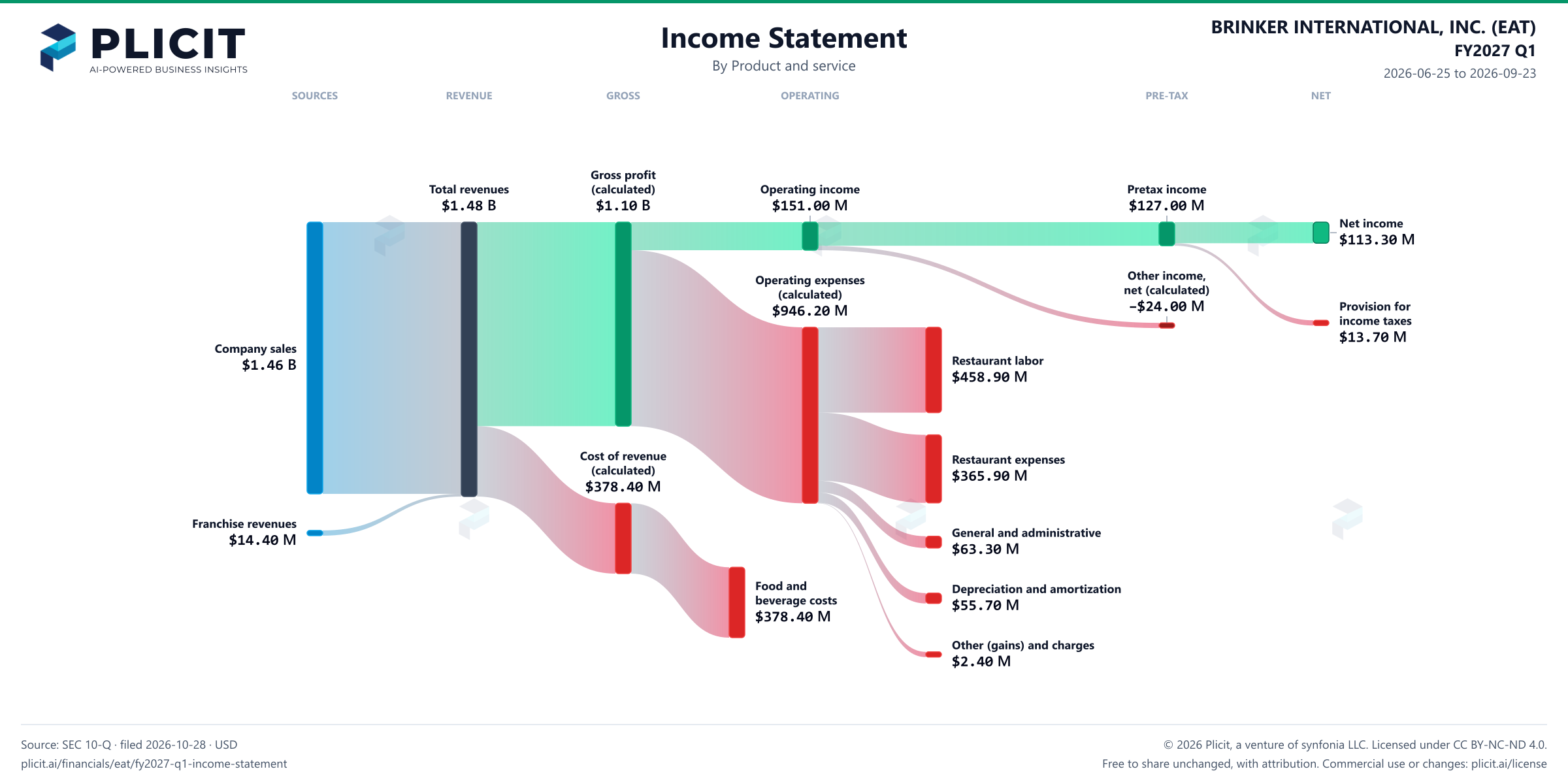
Buybacks lifted per-share profit 22% while profit grew 14%
Brinker's profit rose 14% to $113.30 M, and earnings per share rose 22%. The gap between those two numbers comes from the share count, which fell 6%. Operating income rose 28% to $151.00 M on sales that grew 9%, so the core business improved faster than its revenue. Profit is growing, but the story is in the line items below operating income. Interest and tax matter most. Those two lines decide how much of the operating gain reaches shareholders.
Interest rose to $24.60 M from $10.50 M, but $17.6 M of that is the one-time loss on early payoff of the 8.25% notes. Strip the loss out, and underlying interest was $7.00 M, down 33% from $10.50 M a year earlier. Tax went the other way: the effective rate climbed from 7.5% to 10.8%, so taxes did not flatter profit. The tax bill rose from $8.10 M to $13.70 M, faster than the profit it taxes. Each of those lines is small on its own, but together they explain why profit trailed the operating gain.
So the headline cuts both ways: buybacks flatter per-share profit, while a one-time charge makes interest look worse than it is. Without the loss, operating profit would cover interest about 22 times, against 6.1 times as reported. That is the coverage figure a lender would test, and reported coverage hides it. A reader should not mistake a 22% per-share gain for a faster-growing business, because sales grew 9%. Will the per-share gain survive if the share count stops falling?