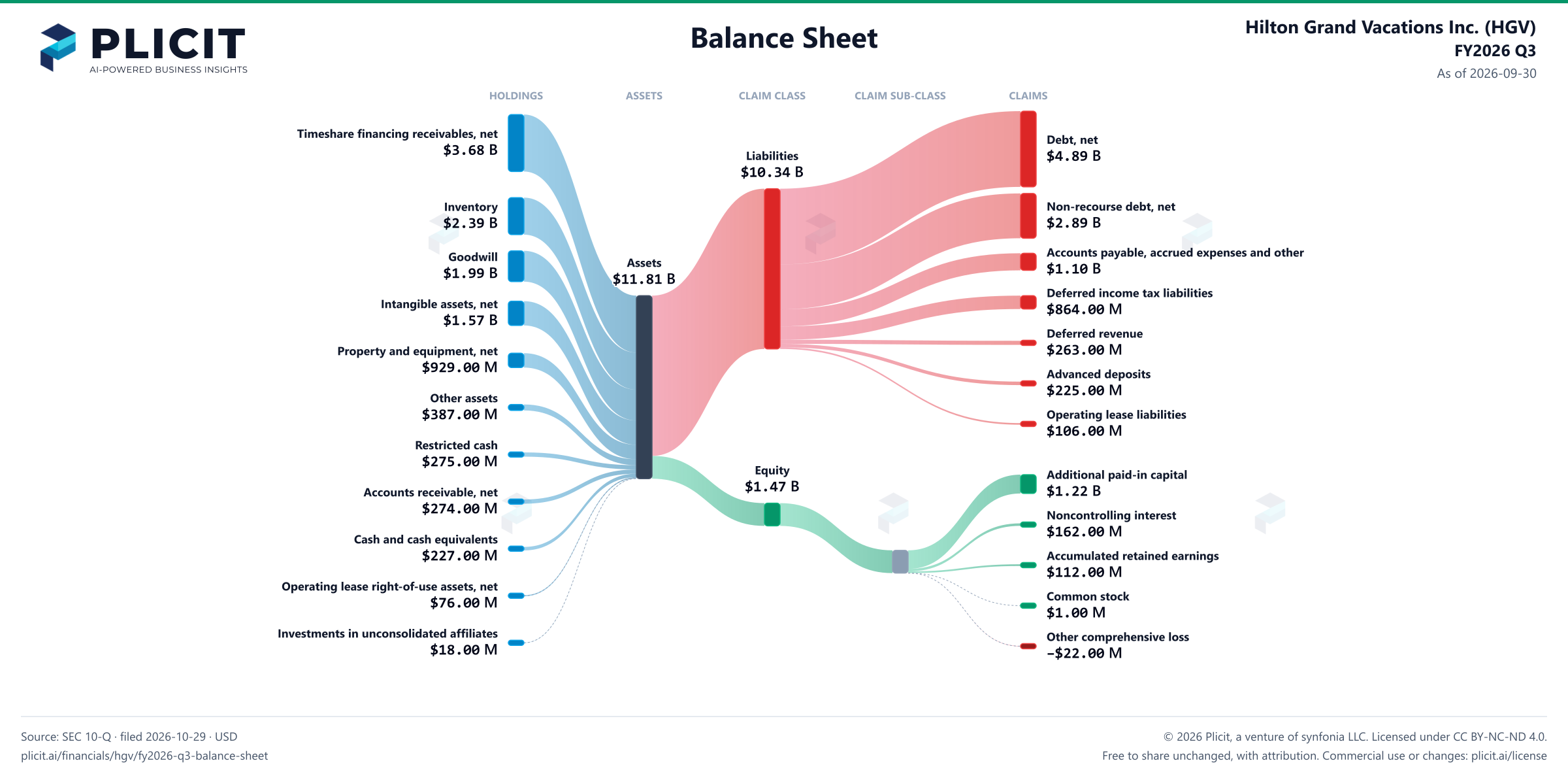
Without its acquisitions, Hilton Grand Vacations owes more than it owns
Hilton Grand Vacations' biggest asset is money its buyers owe it. Timeshare financing receivables, the loans the company makes to buyers of its timeshares, stood at $3.68 B on September 30, 2026, which is 31% of everything it owns. That is about 16 times the $227.00 M of cash and cash equivalents on hand. The filing says another $275.00 M of cash is restricted, primarily escrow deposits from timeshare sales, which it calls VOI sales, and reserves tied to non-recourse debt, so restricted cash is 55% of the $502.00 M total. The loans are the bet this balance sheet makes, and the rest of the story turns on whether they get repaid.
The loan book grew, and so did the question of how much of it will be paid. Gross originated loans rose from $3.67 B at year-end to $4.13 B, while the reserve against them rose only from $1.08 B to $1.17 B. On those figures the reserve covered 29.4% of the loans at year-end and 28.4% on September 30. In the third quarter the company changed how it estimates that reserve, and the filing says the change cut the originated allowance by $55.00 M. A smaller reserve lifts sales, so part of the sales line now rests on an estimate rather than on a buyer's payment record.
Add the non-recourse borrowings, such as the Timeshare Facility, which is payable solely from pledged loans, and total debt comes to $7.78 B. After goodwill and intangibles are taken out, stockholders' equity is negative $2.25 B. The filing also commits the company to $10.10 B of contractual obligations over 14 years. Alongside those obligations sit $1.30 B of notes that are current on payments but not yet securitized. Will customers keep paying on the loans the new reserve model assumes, or will the $55.00 M release turn out to have been borrowed from future quarters?