Morningstar's debt rose 57% since year-end while its equity fell
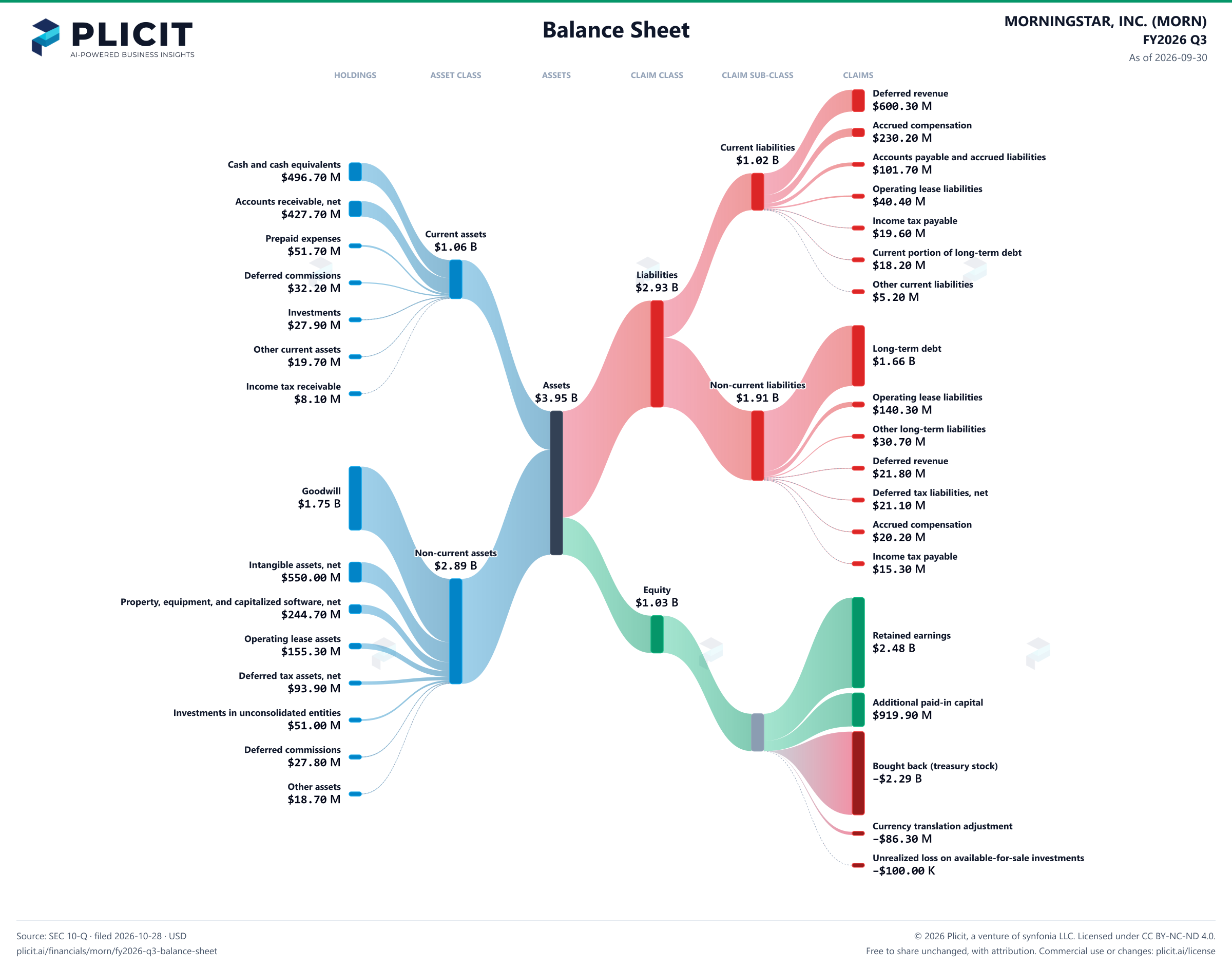
Morningstar owed $1.68 B on September 30, 2026, which is $606.10 M more than it owed at the last year-end. The term facility rose from $373.50 M to $739.50 M, and the revolving credit line rose from $350.00 M to $590.00 M. The company's notes say those borrowings refinanced older debt, paid fees, funded the purchase of CRSP, a stock market data business, and covered general needs. Meanwhile, in the first nine months of 2026 share buybacks took $500.00 M of cash, so the borrowing did not sit idle.
Retained earnings, the profit kept in the business over its life, rose 12% to $2.48 B. Total equity still fell to $1.03 B, as treasury stock, shares the company bought back and now holds, grew by $502.50 M. Cash, cash equivalents and investments totaled $524.60 M, against $1.68 B of debt. Management says it is in compliance with its covenants, with debt at about 1.8x earnings before interest, taxes, depreciation and amortization. The ratios are tested every quarter, so the room can shrink quickly.
For a reader, the arithmetic is blunt: $1.68 B of debt sits against $496.70 M of cash on hand, and that gap is the company's real exposure to lenders. Part of that debt floats with rates, and a 100 basis-point rise in SOFR, the benchmark rate, would add $13.30 M a year to its interest bill. What settles the mystery is whether the debt shrinks once buybacks slow, or whether the next repurchase program pushes it higher over the next year?