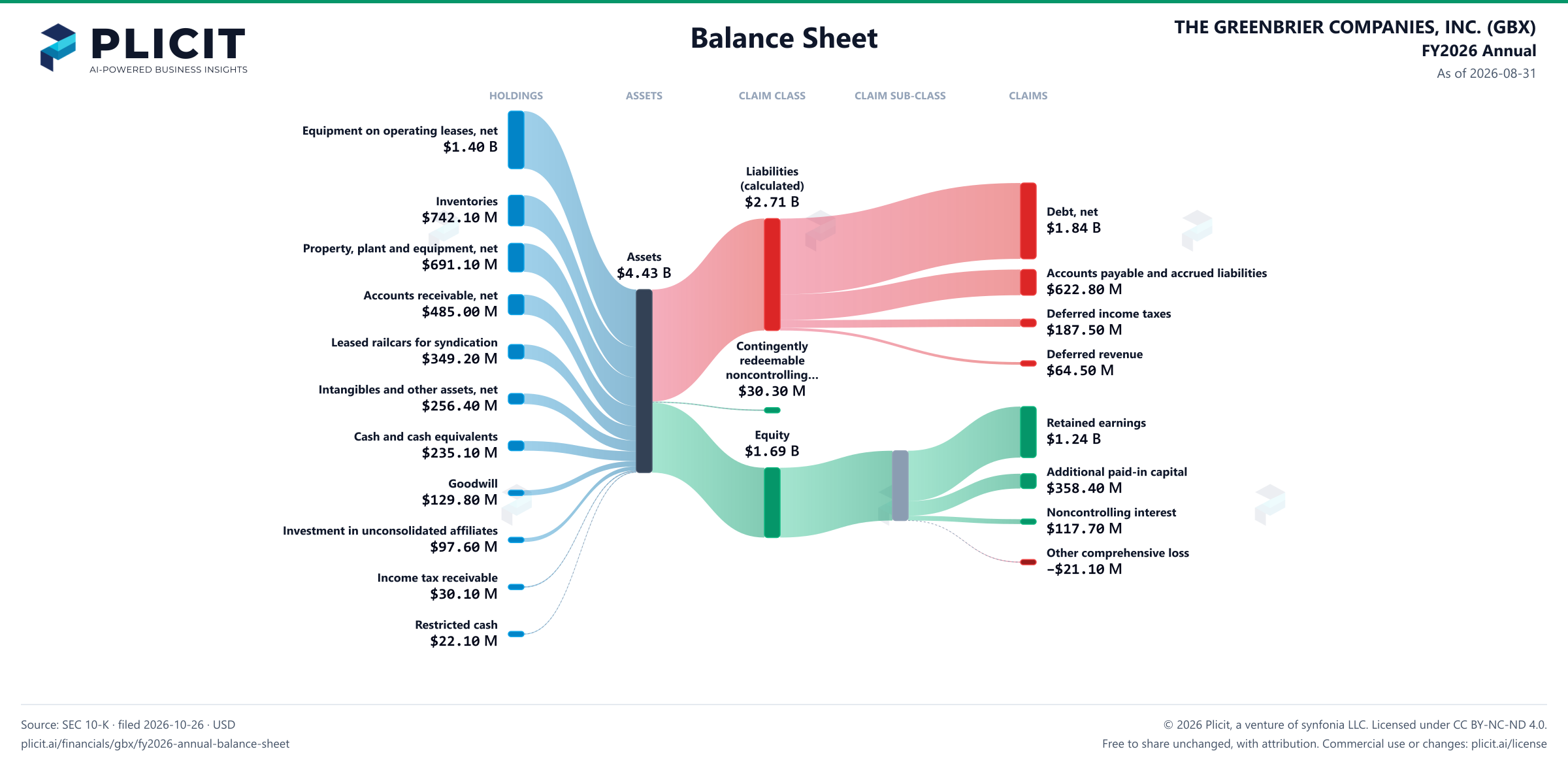
Greenbrier borrowed more as cash shrank and debt hit $1.84 B
Greenbrier sales fell 24% in the year to August 31, 2026, and the balance sheet shows who paid for the slump. Debt climbed to $1.84 B from $1.75 B, while the bank balance dropped to $235.10 M from $306.10 M. That cash would cover just 13% of what it owes lenders. Creditors now fund most of the business: liabilities stand behind 61% of its $4.43 B of assets. Why borrow more in a down year? Because the cash that operations used to throw off largely vanished, and the railcar factories kept building inventory.
Operations brought in only $39.60 M of cash in the year, down 85% from $265.70 M, while Greenbrier spent $279.30 M on property and equipment. Management blames "a $131.5 million decrease in Net earnings and a $79.2 million net change in working capital accounts, primarily Inventories." Inventory rose to $742.10 M from $688.30 M even as deliveries fell. Unpaid customer bills fell just 8% against a 24% drop in sales, leaving $485.00 M owed by customers. The gap was bridged with debt: new borrowing beat repayments by $92.20 M.
For lenders and shareholders, the calendar matters: $181.70 M of debt is due within a year, against $235.10 M of cash, and $445.40 M falls due the year after. Greenbrier also reports $727.2 million of available borrowings, which buys time. The business earned only about 3.5 cents a year on each dollar of capital, and that thin return now carries more debt. Watch whether the inventory turns into delivered railcars and cash. If the backlog keeps shrinking, can the factories pay down a debt pile that grew while sales fell?