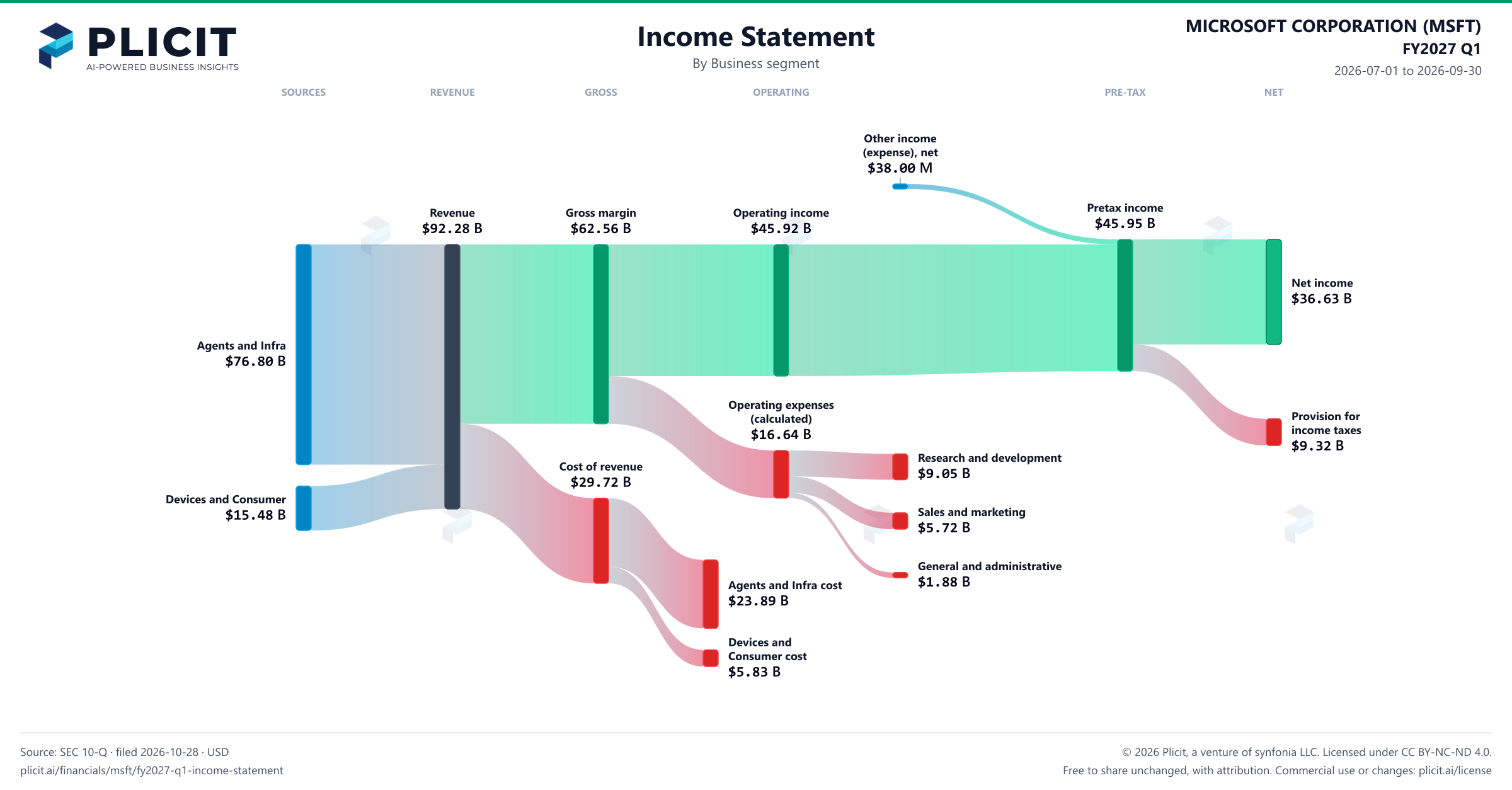
59% of Microsoft's goodwill sits in its shrinking consumer segment
Microsoft's new segment map puts nearly all the profit in Agents and Infra. That segment brought in $76.80 B of the $92.28 B in sales this quarter and $40.56 B of the $45.92 B in operating income, 88% of it. Its revenue rose 25%, but its cost of revenue rose 35%, which management attributes to investments in datacenter infrastructure to support growing customer demand across Azure and Microsoft 365 cloud. Its operating margin, the share of sales kept as operating income, slipped to 52.8% from 53.1% a year earlier.
Devices and Consumer is the rest of the story, and it is shrinking. Its revenue fell 3.2% to $15.48 B; Windows OEM and devices revenue dropped 22%, which management puts down to the benefit from Windows 10 end of support demand in the prior year, inventory drawdowns by OEM and channel partners and weaker PC market demand. Its operating income still rose 2%, helped by lower amortization of intangible assets from the Activision Blizzard acquisition. Yet this segment carries $70.69 B of goodwill, 59% of the total, after Microsoft reallocated goodwill across the new segments and found no impairment. Why does the shrinking business hold most of the acquisition premium?
For investors the split is plain: Microsoft is now an Agents and Infra company with a consumer arm attached, and 83% of sales ride on it. That concentration is both the growth engine and the risk. The datacenter build behind it shows up in cost of revenue first, and the segment's margin has already slipped. Management allocates operating expenses for AI infrastructure and training across segments generally based on relative gross margin, so the split of costs is a judgment as much as a fact. If Devices and Consumer keeps shrinking, will the $70.69 B of goodwill it carries survive the next impairment test?